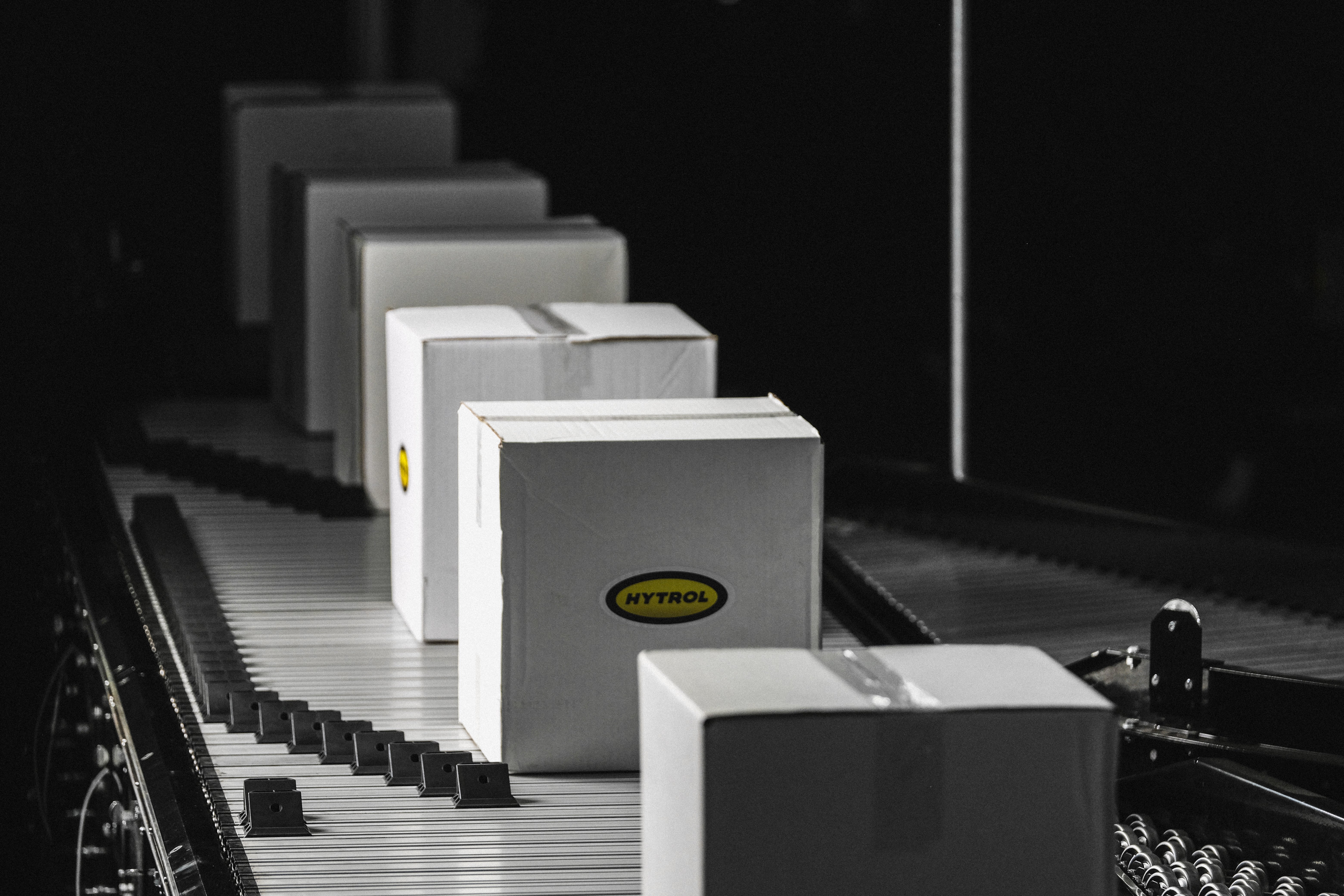
As e-commerce continues to grow, shoe sortation grows with it. These sorters can handle a variety of products in different shapes and sizes and can be utilized in industries ranging from food and beverage to consumer products to parcel handling.
One thing that hasn’t changed unfortunately, is how many companies approach and implement product placement on their conveyor systems. Something so seemingly simple has a massive impact on product safety and conveyor longevity.
The proper placement of product on a sliding shoe sorter is a question every material handling expert must answer when implementing this type of solution. For years, it was commonly taught that one advantage of using a sliding shoe sorter was there is no need for carton justification. Although it is true that a shoe sorter can positively and effectively sort cartons in any position over the width of the conveying surface, there are advantages associated with carton placement, especially when dealing with small cartons, close gaps, and high rates.
When considering product alignment on a sliding shoe sorter with a mixture of large and small, especially small and square, cartons, the ideal placement of cartons is on the side of the conveyor opposite your shoe’s home position. In other words, the ideal placement of cartons is on the divert side of the conveyor. If that sounds off to you, you’re not the only one. Inducting products near the shoe home position has been the general, albeit incorrect, assumption for years, and there are a few important reasons this placement isn’t ideal in some situations.
Problem 1: Bad Physics
Some think when a shoe makes contact with a product closer to the shoe, it creates less impact to the carton than waiting to impact it after the shoe traveled a distance across the sorter. The fact is, it doesn’t matter whether the impact happens near the shoe side or divert side of the sorter, it is the same impact every time if the angle is consistent.
There are solutions that exist to lessen the impact of the shoe to the carton such as lessening the divert angle which is very effective in minimizing carton toppling.
Problem 2: Rotation from Extended Contact
The second problem with justifying cartons on the shoe side is that the shoes have to push the diverting carton the full width of the sorter which increases the risk of carton rotation. The farther you push it, the greater the chance the product will rotate. Also, when sorting small square products or products with convex bottoms from the shoe side it is almost certain to rotate. Carton rotation will often result in the carton spinning around behind the diverting shoes resulting in a missed divert and the carton going to recirculation thus reducing output and efficiency. Rotation can also result in half diverting the carton resulting in a jammed condition and sorter stoppage.
Minimizing the distance from the carton to the divert lane by using divert side justification of cartons eliminates opportunities of missed diverts due to carton rotation. It also allows higher carton rates to be effectively sorted by applying smaller gaps and getting higher carton rates at lower sorter speeds.
Problem 3: Carton striking the shoes in home position
A third problem that is likely to occur if cartons are aligned to the home position of the shoes is the potential of the rear of the carton rotating towards the shoes in the home position and striking the shoes that are going through the divert switch which is not ideal. This problem is particularly evident when sorting long cartons. The weight distribution of the carton and whether the bottom of the carton is convex in shape will determine the point at which the carton rotates when moving into divert position. Generally, the rear of the carton will rotate in the opposite direction of the front of the carton, which means the rear is moving toward the shoes in the home position. Depending on the weight and rotation speed, the rear of the carton, if positioned next to the divert shoes in the home position, can exert an impact load to the shoes going through the divert switch and potentially cause damage to the divert switch or shoe pin track.
Placing the product further from the shoe’s home position decreases the risk of shoe pin damage or damage to the switch.
Summary
High-speed linear sortation is important to the material handling industry. While there are nearly no hard-and-fast rules when it comes to conveying products because of the huge range, keep this thought in mind when you implement shoe sorters: perfect product placement may not be what you thought it was. Normally, the ideal position for carton justification is on the divert side of the sorter for single sided sorters. For dual-sided sorters, it should be not too close to the home position of the shoes, as this could cause impact to the shoes in the home position when sorting.
For a printable version of this blog complete with graphics showing proper product placement, click here.